PsS future: the futures settlement price
PsS future stands for previous session settlement, future: the official daily price that the exchange — for example CME for ES, Eurex for FDAX — sets for the main future. It is the future's official daily price: every open position is valued at it, and it is set at the moment the stock market closes, while the future itself keeps trading. Basics draws it on the main future and on its micros — CME settles micros at the same price as their mini contract — so there the line is the settlement as it is. On CFDs such as US30 or GER40, which follow the official index rather than the future, Basics converts it with the current cash-future difference, so the line lands where it belongs on the CFD chart. This page explains what the line shows, when the settlement is set and how to adjust it.
On this page
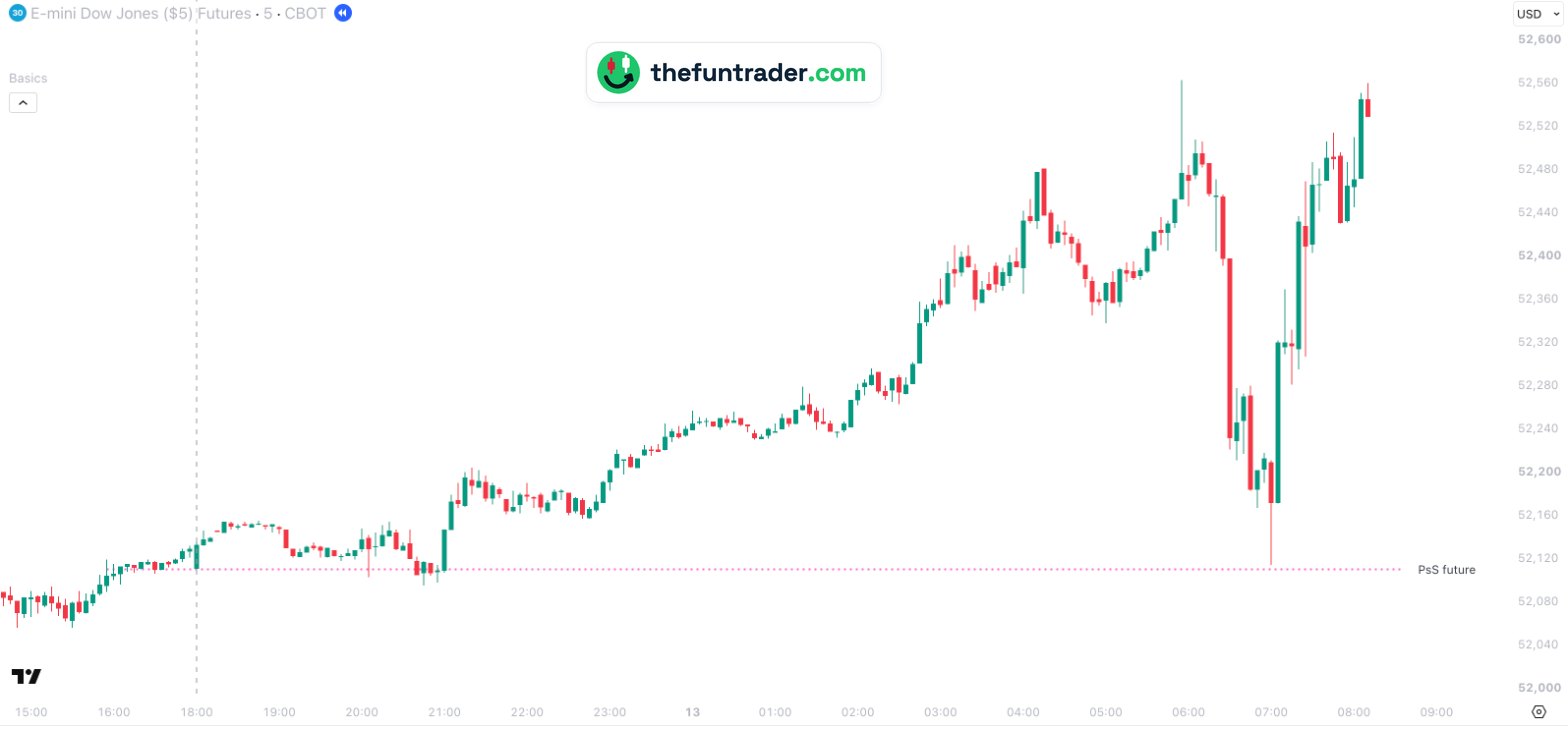 16:00 · settlement is set
123

- 1Monday 16:00 — CBOT (CME Group) sets YM's settlement for the day: 52,110. The line starts at that moment. In the evening YM dips to the line twice, briefly 15 points below it, and climbs from there.
- 2Tuesday 06:05–07:00 — YM falls from 52,508 to 52,114 within an hour and stops 4 points above the settlement.
- 307:00–07:45 — buyers step in at the settlement: YM climbs 400 points back to 52,514 within 45 minutes.
Part of Basics
Free TradingView indicator with all session, week and month levels for index, futures and CFD charts.
Install Basics (free) →Part of Straydog Zones & Levels
TradingView indicator that draws the daily DAX zones and levels from Straydogtrading.com on index, CFD and futures charts.
Install Straydog →What the settlement price is
Every trading day the exchange sets one official price for each futures contract: the daily settlement. All open positions are valued at it, profits and losses are booked against it, and margin is calculated from it. That makes it the future's official close of the day — the number the exchange, brokers and clearing houses work with.
The settlement is not simply the last trade. The exchange calculates it from the trades in a short window:
| NQ, ES, YM, RTY (CME) | Volume-weighted average price of the trades between 15:59:30 and 16:00:00 New York time |
|---|---|
| FDAX (Eurex) | Volume-weighted average price of all trades in the minute before 17:30 Berlin time (if more than five trades take place) |
| FTSE 100 future (ICE Futures Europe) | Set from the trades in the window 16:28–16:30 London time |
| AEX future (Euronext) | The daily settlement price that Euronext publishes for the contract |
| Micros (MNQ, MES, MYM, M2K) | The settlement of their mini contract (CME) |
The CME, Eurex and ICE windows fall exactly on the stock market close. The futures themselves keep trading: US index futures until 17:00 New York time, the DAX future until 22:00 Berlin time. When too few trades take place in the window, the exchanges use fallback rules.
Three different closes
For an index future there are three prices that can all be called "yesterday's close". Basics draws each as its own line:
| PsS future | The exchange's settlement, set at the stock market close (this page) · pink, dotted |
|---|---|
| PsC index | The official close of the index itself at the same moment, converted to futures prices · pink, solid |
| PsC future | The future's last traded price at the end of its own session (17:00 New York, 22:00 Berlin) · pink, dashed |
On Monday 12 October, where the line in the chart above starts, the three were: settlement 52,110, YM's last price at 16:59 52,129, and the Dow close in YM prices about 52,093. Close together, but not the same — and on the next morning YM turned just above the settlement.
Why traders watch it
The settlement is where the futures market officially ends its day. Traders who hold positions overnight are measured against it, and many platforms use it as the daily closing price of a future — on TradingView, a daily futures candle closes at the settlement when settlement as close (the SET button) is switched on. Because so many participants see the same number, price often reacts when it comes back to it.
How Basics shows it
PsS future is not only for futures traders. Basics also draws it on CFD and index charts, converted with the cash-future difference — on US30 or on the Dow itself, for example, the line sits where the settlement belongs on that chart.
| Default look | Pink, dotted, width 2 |
|---|---|
| Label on the chart | PsS future (renamable) |
| Switched on by default | Yes |
| Value | The exchange's daily settlement of the main future in the previous session |
| Where the line starts | At the moment the settlement is set: the stock market close (16:00 New York, 17:30 Berlin); it appears when the next session begins |
| Timeframes | Charts from 1 minute up to the daily chart, on seconds charts too, unless the level needs more history than the chart loads; not on weekly or monthly charts |
| Markets | Nasdaq-100, S&P 500, Dow, Russell 2000, DAX, FTSE 100 and AEX — all tickers |
| Price on your chart | Futures (main, mini, micro, nano): the main future's settlement as it is. CFD and index charts: converted with the current cash-future difference |
| Lookback | 1 — the previous session only (up to 20 sessions, set in the indicator settings) |
The same settlement on other instruments
Click a chart to enlarge it.


Why don't I see the line?
- The settlement has only just been set.Today's settlement becomes PsS future when the next session begins — for US futures at 18:00 New York time. Until then you still see the previous one.
- You are on a weekly or monthly chart, or a seconds chart.The line is drawn on charts from 1 minute up to the daily chart. On a seconds chart, a level that needs more history than the chart loads is hidden.
- Price is far away from it.Lines are hidden while the level is more than 5 % from the current price, so they don't squeeze the chart. You can change this under General → Level visibility range.
- It is switched off.Check the PsS future box and the master switch Show all objects in 'Futures levels' group in the indicator settings.
- Your ticker is not recognised.See the supported tickers — and if yours is missing, let me know: requests are very welcome.
What you can change
Everything about the line can be adjusted in the indicator settings (the gear icon next to Basics on your chart), under Futures levels.
| Show / hide | PsS future checkbox · Futures levels |
|---|---|
| Colour, width, style | Any colour · width 1–5 · solid, dashed or dotted |
| Label text | Default PsS future |
| Lookback | 1–20 sessions (default 1: the previous session only) |
| Label size, line end, visibility range | Shared with all lines · General |

Charts and defaults on this page: Basics v11.72.8 · updated 21 October 2026. Settlement rules: Eurex DAX futures contract specifications · CME equity index daily settlement procedure.
Frequently asked questions
What is the settlement price of a future?
The official daily price the exchange sets for a futures contract. All open positions are valued at it at the end of the day, and margin is calculated from it. It is the future's official daily price.
When is the settlement of ES or NQ set?
CME uses the volume-weighted average price of the trades between 15:59:30 and 16:00:00 New York time, when the US stock market closes. The futures themselves keep trading until 17:00.
When is the settlement of the DAX future set?
Eurex uses the volume-weighted average price of all trades in the minute before 17:30 Berlin time, provided more than five trades take place in that minute. FDAX keeps trading until 22:00.
Is the settlement the same as the last price of the day?
No. The future keeps trading after the settlement is set, so its last price usually differs. Basics draws the last price as a separate line, PsC future.
Do micros such as MES or MYM have their own settlement?
According to CME, a micro contract settles at the settlement of its mini contract. On micro charts Basics shows the main future's settlement — for example ES on MES, or YM on MYM.
Related levels
See PsS future on your own chart
Basics is free on TradingView. Add it to any supported chart — for example YM or a US30 CFD — and the previous settlement appears without any setup.